

Abstract Filament-based material extrusion has evolved from a low-cost prototyping technique into a manufacturing process increasingly considered for functional and quality-critical applications. However, its industrial adoption remains constrained by a persistent traceability gap between planned process parameters and final part outcomes. During fabrication, heterogeneous monitoring [...]

Abstract Additive manufacturing (AM) has faced challenges in achieving the part accuracy required for industrial adoption. Most research has focused on offline inspection of geometric deviations in test parts. This paper introduces a novel approach to enhance part accuracy and process control in Polymer Extrusion [...]

Abstract The TEDI project is a 36-month Erasmus+ Cooperation Partnership in Higher Education (KA220-HED) running from September 2024 to August 2027, co-funded with a grant of €250,000. Coordinated by Rzeszów University of Technology (Poland) alongside Kaunas University of Technology (Lithuania) and the University of Oviedo [...]

Abstract The processes utilized for Additive Manufacturing (AM) production of metallic parts usually entail the use of hazardous feedstocks, expensive production equipment, and high energy consumption. Metal Material Extrusion AM (MEX/M) presents an alternative multi-step approach that addresses these challenges by additively extruding polymer-metal composite [...]
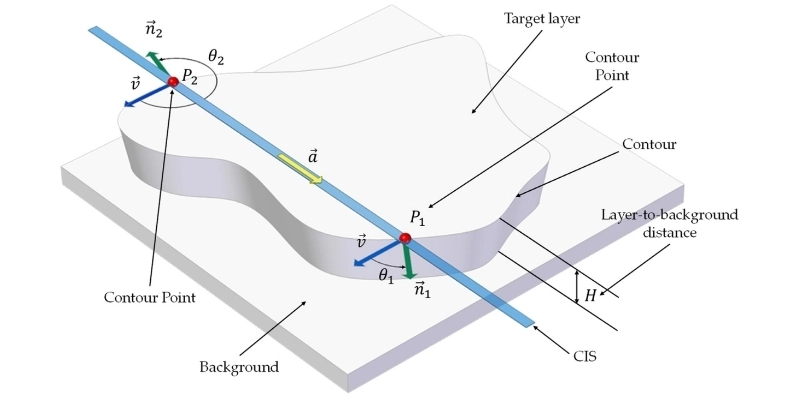
Abstract: The industrial adoption of material extrusion of polymers (MEX/P) is hindered by the geometric quality of manufactured parts. Contact image sensors (CISs), commonly used in flatbed scanners, have been proposed as a suitable technology for layer-wise characterization of contour deviations, paving the way for [...]
Feasibility of Conoscopic Holography Measurement in the Stereolithography (SLA) Process with Alumina
Abstract As additive manufacturing technologies continue to gain ground in industrial applications, the need for the accurate metrological evaluation of parts produced with advanced materials becomes increasingly critical. In this context, non-contact metrology plays a key role. This research investigates the performance of conoscopic holography [...]
Abstract Filament-based material extrusion has evolved from a low-cost prototyping technique into a manufacturing process increasingly considered for functional and quality-critical applications. However, its industrial adoption remains constrained by a persistent traceability gap between planned process parameters and final part outcomes. During fabrication, heterogeneous monitoring [...]
Abstract Surface quality in material extrusion of polymers (MEX/P) plays a critical role in determining the functional performance of printed parts, especially in components that must work together and in sectors such as medical and aerospace. Predicting surface quality before printing shall be therefore considered [...]
Abstract Additive manufacturing (AM) has faced challenges in achieving the part accuracy required for industrial adoption. Most research has focused on offline inspection of geometric deviations in test parts. This paper introduces a novel approach to enhance part accuracy and process control in Polymer Extrusion [...]
Abstract The project aims to develop and optimize the additive manufacturing of metal parts using Metal Extrusion (MEX/M) as an alternative to conventional metal powder-based technologies, with the goal of reducing costs, energy consumption, and the risks associated with the handling of raw materials. The [...]
Abstract The TEDI project is a 36-month Erasmus+ Cooperation Partnership in Higher Education (KA220-HED) running from September 2024 to August 2027, co-funded with a grant of €250,000. Coordinated by Rzeszów University of Technology (Poland) alongside Kaunas University of Technology (Lithuania) and the University of Oviedo [...]
Abstract The processes utilized for Additive Manufacturing (AM) production of metallic parts usually entail the use of hazardous feedstocks, expensive production equipment, and high energy consumption. Metal Material Extrusion AM (MEX/M) presents an alternative multi-step approach that addresses these challenges by additively extruding polymer-metal composite [...]
Abstract: The industrial adoption of material extrusion of polymers (MEX/P) is hindered by the geometric quality of manufactured parts. Contact image sensors (CISs), commonly used in flatbed scanners, have been proposed as a suitable technology for layer-wise characterization of contour deviations, paving the way for [...]
Abstract The variety of equipment implementing laser triangulation technology for 3D scanning makes it difficult to analyse their performance, comparability, and traceability. In this study, three laser triangulation sensors arranged in different configurations are analysed using high precision spheres made of different materials and surface [...]
Abstract Additive Manufacturing (AM) is advancing technologically towards the production of components for high-demand mechanical applications with stringent dimensional accuracy, leveraging metallic and ceramic raw materials. The AM process for ceramic components, known as Ultraviolet Laser Stereolithography (SLA), enables the fabrication of unique parts or [...]
Feasibility of Conoscopic Holography Measurement in the Stereolithography (SLA) Process with Alumina
Abstract As additive manufacturing technologies continue to gain ground in industrial applications, the need for the accurate metrological evaluation of parts produced with advanced materials becomes increasingly critical. In this context, non-contact metrology plays a key role. This research investigates the performance of conoscopic holography [...]
Abstract Filament-based material extrusion has evolved from a low-cost prototyping technique into a manufacturing process increasingly considered for functional and quality-critical applications. However, its industrial adoption remains constrained by a persistent traceability gap between planned process parameters and final part outcomes. During fabrication, heterogeneous monitoring [...]
Abstract Surface quality in material extrusion of polymers (MEX/P) plays a critical role in determining the functional performance of printed parts, especially in components that must work together and in sectors such as medical and aerospace. Predicting surface quality before printing shall be therefore considered [...]
Abstract Additive manufacturing (AM) has faced challenges in achieving the part accuracy required for industrial adoption. Most research has focused on offline inspection of geometric deviations in test parts. This paper introduces a novel approach to enhance part accuracy and process control in Polymer Extrusion [...]
Abstract The project aims to develop and optimize the additive manufacturing of metal parts using Metal Extrusion (MEX/M) as an alternative to conventional metal powder-based technologies, with the goal of reducing costs, energy consumption, and the risks associated with the handling of raw materials. The [...]
Abstract The TEDI project is a 36-month Erasmus+ Cooperation Partnership in Higher Education (KA220-HED) running from September 2024 to August 2027, co-funded with a grant of €250,000. Coordinated by Rzeszów University of Technology (Poland) alongside Kaunas University of Technology (Lithuania) and the University of Oviedo [...]
Abstract The processes utilized for Additive Manufacturing (AM) production of metallic parts usually entail the use of hazardous feedstocks, expensive production equipment, and high energy consumption. Metal Material Extrusion AM (MEX/M) presents an alternative multi-step approach that addresses these challenges by additively extruding polymer-metal composite [...]
Abstract: The industrial adoption of material extrusion of polymers (MEX/P) is hindered by the geometric quality of manufactured parts. Contact image sensors (CISs), commonly used in flatbed scanners, have been proposed as a suitable technology for layer-wise characterization of contour deviations, paving the way for [...]
Abstract The variety of equipment implementing laser triangulation technology for 3D scanning makes it difficult to analyse their performance, comparability, and traceability. In this study, three laser triangulation sensors arranged in different configurations are analysed using high precision spheres made of different materials and surface [...]
Abstract Additive Manufacturing (AM) is advancing technologically towards the production of components for high-demand mechanical applications with stringent dimensional accuracy, leveraging metallic and ceramic raw materials. The AM process for ceramic components, known as Ultraviolet Laser Stereolithography (SLA), enables the fabrication of unique parts or [...]


