
Thesis
Methodology for the improvement of dimensional and geometrical quality in additively manufactured parts
Abstract
Additive manufacturing has undergone a rapid development in recent decades, evolving from prototyping and individual part fabrication to fabrication of functional components and serial production. The progressive reduction of the cost per unit has transformed additive manufacturing into a viable alternative to conventional processes for certain applications.
However, the quality of additively manufactured parts is still lower than that obtained with conventional alternatives. There is a gap between the achievable specifications and the industrial level requirements, that especially significant in the case of dimensional and geometric tolerances.
The thesis presented in this work proposes a methodology to improve the dimensional and geometric quality of additively manufactured parts and help the industrial adoption of additive processes. This methodology is applied to the three-dimensional features of linear size described in the UNE-EN-ISO 14405-1 standard, being the cylindrical surfaces and the opposite parallel planes the most relevant in industry. Similarly, the scope of application is restricted to medium-to-large production series where the improvement effort is fully justified.
The proposed methodology is structured in three consecutive stages: problem analysis, process optimization, and design optimization. The problem analysis stage consists of a data collection and structuring phase, followed by an analysis of the achievable quality for each considered geometry under a standard configuration of the process parameters. During the process optimization stage, dependence of quality variability with configuration variability is studied, and the optimal processing configuration suitable for minimizing quality issues is determined. Finally, the design optimization stage aims at the modification of the 3D theoretical model of the considered feature, in order to reduce the deviation between the manufactured geometry and the target geometry.
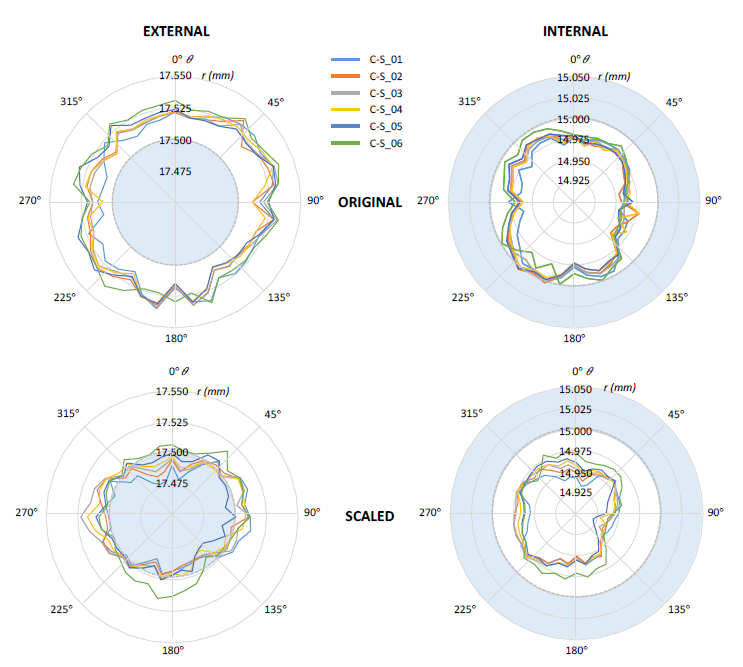
The application of the proposed methodology to different case studies has resulted in three publications in scientific journals included in the Science Citation Index, so this thesis is presented as a compendium of publications. The first publication includes a general description of the proposed methodology, as well as its application to the dimensional and geometric optimization of tibia-resection surgical-steel guides manufactured with powder bed fusion. The process optimization considers the final part including post-processing operations, whereas the design optimization is particularized according to the influence of the location of each part within the workspace. In the second publication, a dimensional and geometric optimization of cylindrical surfaces built on an acrylic photopolymer with a material projection process is carried out. The minimization of dimensional and geometric errors is achieved through a re-parameterization of the geometry, based on a bi-univocal verification and parameterization model. The third publication deals with the dimensional optimization of cylindrical surfaces built on thermoplastic material with a material extrusion process. A multi-state perspective, based on the machine performance analysis techniques described in ISO 22514 series is applied to the reduction of the achievable tolerance intervals.
The application of the proposed methodology has allowed an improvement of the quality of the pieces in each case study. Its generalized application in the scope of this thesis would contribute to facilitate the industrial adoption of additive processes.
Thesis data
Type: PhD
Author: N. Beltrán
Supervisor:D. Blanco, Al Noriega
Related project: DPI2017-83068-P
Abstract:
Date: 19/09/2021
Other thesis
- septiembre 17, 2023|


