Pablo Zapico García
Senior Lecturer
+34 985182217
ORCID code: 0000-0001-8055-8650
Short CV:
Pablo Zapico obtained an MSc in mechatronics and a PhD from the University of Oviedo in 2014 and 2017, respectively. From 2018 to 2020, he worked as a post-doctoral researcher in the AM field in the Department of Mechanical, Informatics and Aerospace Engineering at the University of León. In 2020, he joined the Department of Construction and Manufacturing Engineering at the University of Oviedo as Assistant Lecturer. His current research is focused on non-contact inspection applied to manufacturing engineering, especially aimed at the integration of non-contact technologies in AM machines. He has participated in several research projects, and the obtained results have been reflected in numerous publications in journals of high impact as well as in national and international conference presentations.
Publications
Abstract Additive Manufacturing (AM) is advancing technologically towards the production of components for high-demand mechanical applications with stringent dimensional accuracy, leveraging metallic and ceramic raw materials. The AM process for ceramic components, known as Ultraviolet Laser Stereolithography (SLA), enables the fabrication of unique parts or [...]
Publications
Abstract Material Extrusion (MEX) currently stands as the most widespread Additive Manufacturing (AM) process, but part quality deficiencies remain a barrier to its generalized industrial adoption. Quality control in MEX is a complex task as extrusion performance impacts the consistency of mechanical properties and the [...]
Publications
Abstract The purpose of this paper is to provide a new procedure for in-plane compensation of geometric errors that often appear in the layers deposited by an additive manufacturing (AM) process when building a part, regardless of the complexity of the layer geometry. The procedure [...]
PhD,Theses
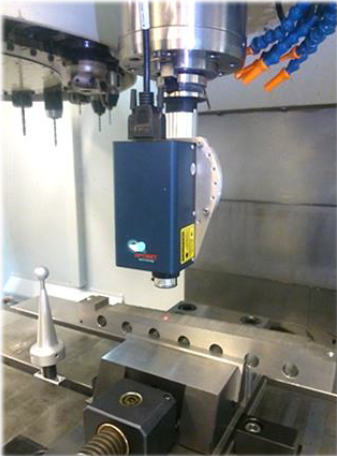
Abstract This Doctoral Thesis investigates the feasibility of integrating non-contact sensors based on Conoscopic Holography (CH) technology into CNC production machines for inspection and verification tasks. A practical integration methodology was developed, comprising three levels: physical installation of the sensor, calibration of the machine-sensor system, [...]
Projects,Public Funding Projects
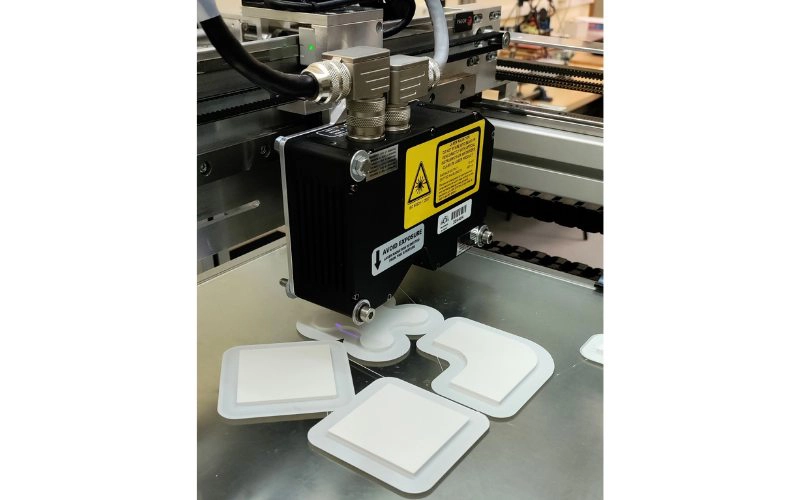
Abstract: Additive manufacturing processes are opening up a world of possibilities towards obtaining parts with complex geometry and adjustable properties. Its impact in sectors such as biomechanics, energy or aerospace is already appreciable, but the forecasts point to a real revolution linked to the development [...]
Publications
Abstract The great geometric complexity that additive manufacturing allows in parts, together with the possibility of combining several materials in the same part, establishes a new design and manufacturing paradigm. Despite the interest of many leading sectors, the lack of standardization still makes it necessary [...]
Publications
Abstract The lack of geometric and dimensional accuracy of parts produced by additive manufacturing (AM) is directly related to the machine, material and process used. This paper aims to propose a method for the analysis and compensation of machine-related geometric errors applicable to any AM [...]
Publications
Abstract The advantages of non-contact digitising systems over contact systems are undeniable. They allow capturing more information per unit of time with less accessibility problems and without alter the digitised surface. Although many of these systems have been developed with the aim of replacing contact [...]
Publications
Abstract Traditionally, 3D digitizing sensors have been based on contact measurement. Given the disadvantages of this type of measurement, non-contact sensors such as structured light sensors have gained the attention of many sectors in recent years. The fact that their metrological performance is affected by [...]