
A Gaussian filtering method to reduce directionality on high-density point clouds digitized by a conoscopic holography sensor
Abstract:
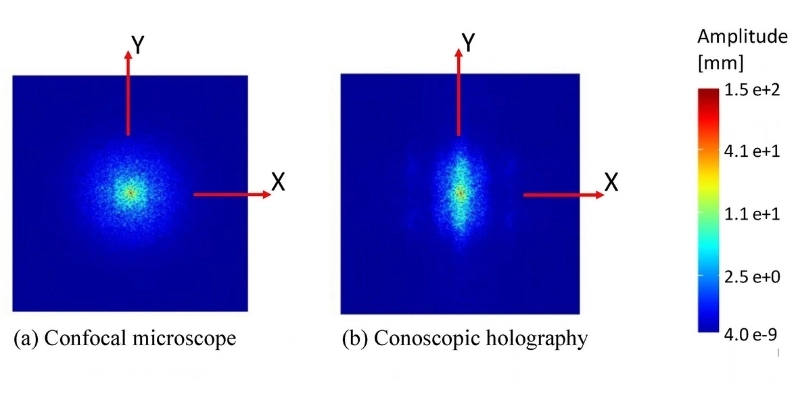
This work analyses the directional effect shown by the high-density point clouds digitized with a conoscopic holography (CH) sensor. The asymmetric shape of the laser spot for this sensor yields directionality to appear along the largest spot dimension and to occur repeatedly under different working conditions. To study this effect, several digitizing tests were performed under different conditions on a surface machined by EDM with a uniform and isotropic finish, so that the directional effect should not appear. Nevertheless, the use of the 2D Fourier transform (2DFT) confirmed the existence of directionality in the point clouds along the largest spot direction and that it appeared repetitively under different working conditions. Thus, this effect could be considered as a systematic error associated to the CH sensor and then, feasible to be reduced. The use of an anisotropic 2D Gaussian filter is suggested for this purpose. The results found before and after applying the filter were compared to those obtained by a confocal microscope, which was used as reference due to the absence of directionality in the captured images. Results show that the filtered point clouds suitably fit the actual surface topography.
Keywords:
Publication data
Authors: H. Patiño, P. Zapico, J.C. Rico, P. Fernández, G. Valiño
Publication: Precision Engineering, 54, 91-98, 2018
DOI: https://doi.org/10.1016/j.precisioneng.2018.05.005
Related project: DPI2012-30987


