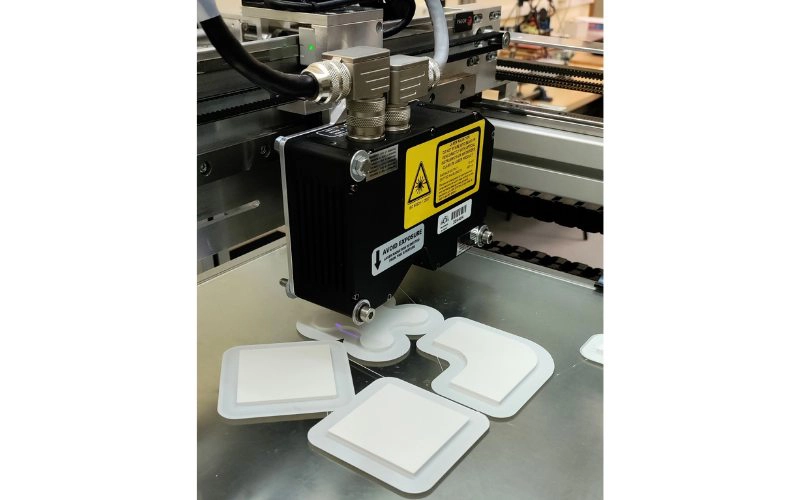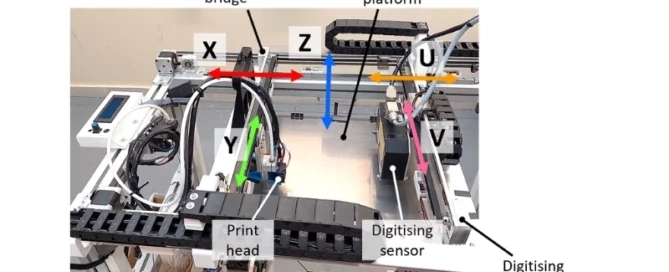
In‑situ digitising system for geometric improvement of layer contours in additive manufacturing

Abstract Additive manufacturing (AM) has faced challenges in achieving the part accuracy required for industrial adoption. Most research has focused on offline inspection of geometric deviations in test parts. This paper introduces a novel approach to enhance part accuracy and process control in Polymer Extrusion [...]
By |2026-09-15T16:42:25+00:00junio 17, 2025|Publications|0 Comments

Accuracy Enhancement of Metal MEX Manufactured Parts through Geometry Compensation and Data-Driven Optimization (AEMMEX)

Abstract The processes utilized for Additive Manufacturing (AM) production of metallic parts usually entail the use of hazardous feedstocks, expensive production equipment, and high energy consumption. Metal Material Extrusion AM (MEX/M) presents an alternative multi-step approach that addresses these challenges by additively extruding polymer-metal composite [...]

By |2026-09-17T17:14:49+00:00septiembre 1, 2024|Projects, Public Funding Projects|0 Comments

Real-time Compensation of Layer Geometry Errors for Additive Manufacturing Processes

Abstract: Additive manufacturing processes are opening up a world of possibilities towards obtaining parts with complex geometry and adjustable properties. Its impact in sectors such as biomechanics, energy or aerospace is already appreciable, but the forecasts point to a real revolution linked to the development [...]

By |2026-09-11T16:18:27+00:00enero 1, 2018|Projects, Public Funding Projects|0 Comments

Engineering of Manufacturing Processes

Abstract The project aims to develop an integrated manufacturing and non-contact dimensional inspection system using sensors based on Conoscopic Holography (CH). To this end, these sensors will be integrated into machine tools, initially three-axis machines, by developing the necessary mounting, communication, control, and calibration systems, [...]

By |2026-09-18T11:57:38+00:00diciembre 30, 2017|Projects, Public Funding Projects|0 Comments

Characterisation of the performance of a structural light digitizing sensor by using different materials and surface finishes

Abstract The advantages of non-contact digitising systems over contact systems are undeniable. They allow capturing more information per unit of time with less accessibility problems and without alter the digitised surface. Although many of these systems have been developed with the aim of replacing contact [...]

By |2026-09-22T10:28:59+00:00junio 14, 2017|Publications|0 Comments

Optical characterisation of materials for precision reference spheres for use with structured light sensors

Abstract Traditionally, 3D digitizing sensors have been based on contact measurement. Given the disadvantages of this type of measurement, non-contact sensors such as structured light sensors have gained the attention of many sectors in recent years. The fact that their metrological performance is affected by [...]

By |2026-09-22T10:35:45+00:00junio 13, 2017|Publications|0 Comments
Go to Top