
Time and Cost Analysis of a Metal Filament Extrusion Additive Manufacturing Process
Abstract
Material extrusion of metallic filament (MEX/M) is a potentially low-cost alternative for manufacturing metal components, as it uses equipment similar to that employed in polymer 3D printing. However, assessing its economic viability requires consideration not only of material deposition, but also of auxiliary operations, component wear and subsequent debinding and sintering treatments.
The aim of this Degree Thesis was to develop an analytical model for estimating the time and costs associated with the MEX/M process as a function of its main manufacturing parameters. To this end, existing models for machining and additive manufacturing processes were reviewed, and their methodologies adapted to the specific characteristics of metal filament extrusion. Equations were formulated to quantify non-productive times, deposition time, nozzle wear, finishing operations and subsequent treatments, as well as material, operating and consumable costs.
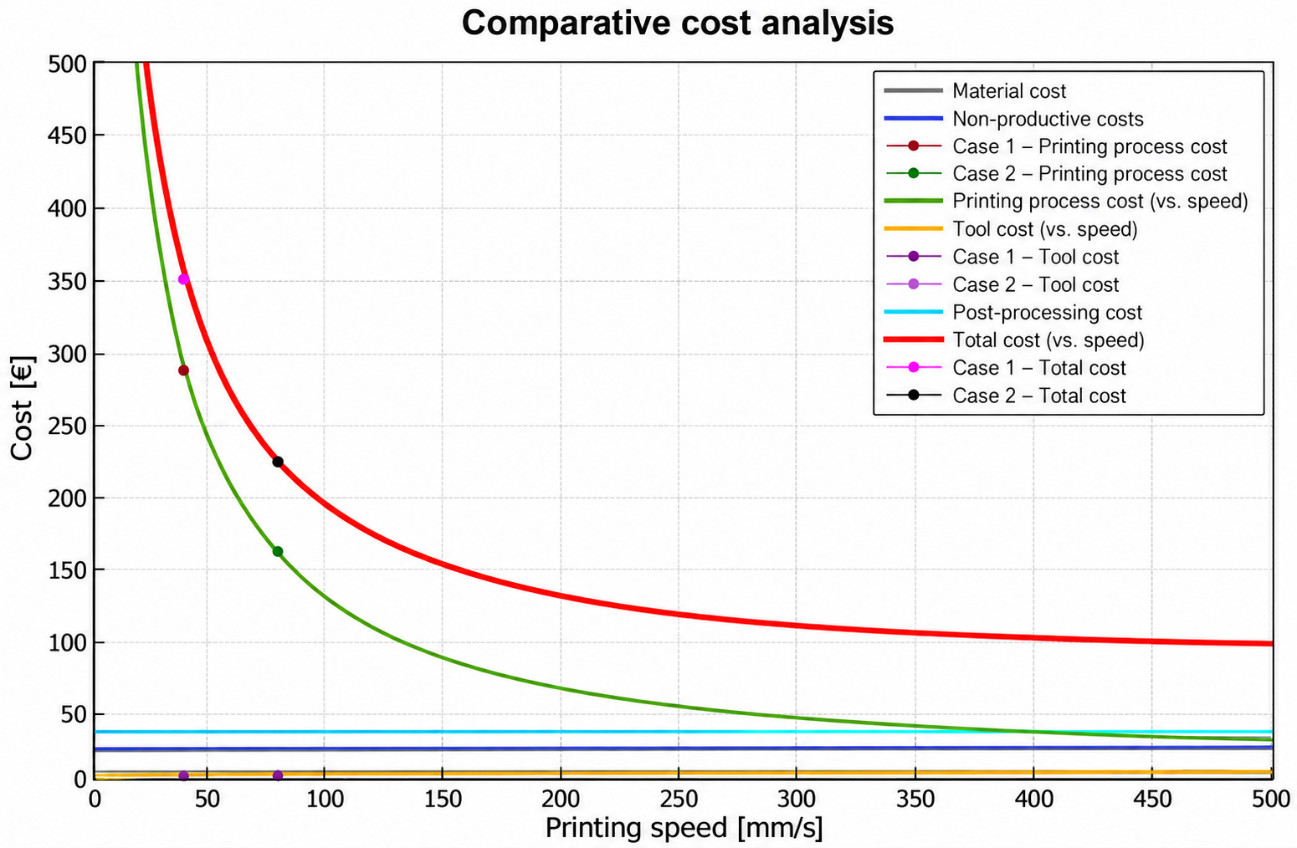
The analysis focused primarily on the 3D printing stage, while debinding and sintering were estimated in less detail. Geometrical and manufacturing parameters were obtained, among other sources, from the Ultimaker Cura slicing software. As a result, a MATLAB application was developed to plot the time and cost functions and analyse the influence of process parameters. Its application to a case study enabled the comparison of two manufacturing conditions, with printing speeds of 40 and 80 mm/s. Under the assumptions considered, the estimated cost per part decreased from €343.53 to €221.52 when the printing speed was doubled. The main contribution of this work is the explicit inclusion of nozzle wear in the economic model, a factor that is particularly relevant when manufacturing batches of parts. The methodology provides a basis for evaluating and optimising the economic efficiency of the M-MEX process. Future research directions include the experimental validation of nozzle wear and a more detailed analysis of the consolidation stages.
Thesis data
Author:
Fernández Sariego, Mario
Supervisor/s:
G. Valiño
Related project:
PID2023-146753OB-I00
Date:
06/07/2023


