
Vertical registration of in-process topography data with post-process volumetric data
Abstract
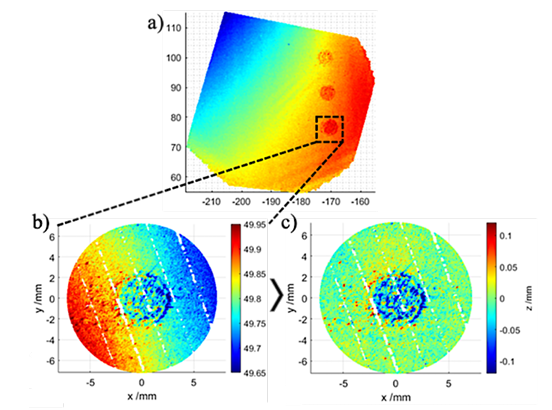
In additive manufacturing, special attention has been paid to the development of in-situ monitoring solutions for layer-by-layer build inspection. The investigation of such paradigms, however, has not always yielded accurate information about the final quality of the part, due to dissimilarities between the irregularities observed in-situ and the anomalies that persist in the final volume. As such, the establishment of meaningful correlations is a critical issue that requires careful investigation. In this work, we explore the laser-beam powder bed fusion process and propose a bespoke method to register in- process surface topography data collected using fringe projection with the post-process part volume acquired using X-ray computed tomography (XCT). The proposed method consists of the co-localisation of the two datasets about the z-axis (vertical registration), following two main steps: the extraction of the in-process lateral surface from topography data, and the vertical alignment of this surface with the reconstructed XCT volume. To extract the in-process lateral surface, the processed regions of each layer were segmented using a convex hull method, then vertically stacked and triangulated to construct a three- dimensional (3D) mesh. Next, manual co-localisation was performed with the XCT model, through the visual identification of geometrical landmarks (curvatures). Layers in the in-process 3D mesh were matched with their corresponding slices in the XCT volume using a vertical moving window of nine slices. In general, this data registration approach allows for the co-localisation of two heterogeneous datasets acquired at different stages of the build (in-process and postprocess), and the obtention of information about the changes induced by consolidation and layer thermal interactions from a lateral surface perspective. Furthermore, the presented method does not require rotational registration on the xy plane, a particularly challenging task given the rotational symmetry of the selected part and the complexity of delimiting in-process part boundaries with confidence.
Keywords
Laser powder bed fusion, In-process, surface topography, Post-process, Volumetric data, Data registration
Publication data
Authors:
A. Remani, F. Peña, A. Rossi, A. Thompson, J. Dardis, N. Jones, N. Senin, R. Leach
Publication:
15th International Symposium on Measurement Technology and Intelligent Instruments (ISMTII2023), Seoul (Korea), 17-20 September 2023
Related Project:


