About Carlos Rico

This author has not yet filled in any details.
So far Carlos Rico has created 171 blog entries.
16 06, 2017

Influence of post-processing on the properties of multi-material parts obtained by Material Projection AM

2026-11-06T12:58:59+00:00

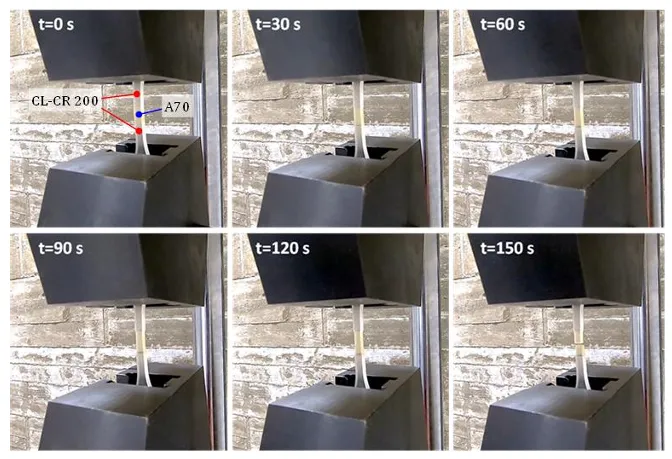
Abstract The great geometric complexity that additive manufacturing allows in parts, together with the possibility of combining several materials in the same part, establishes a new design and manufacturing paradigm. Despite the interest of many leading sectors, the lack of standardization still makes it necessary to carry out characterization work [...]
Influence of post-processing on the properties of multi-material parts obtained by Material Projection AM2026-11-06T12:58:59+00:00
15 06, 2017

Development of Procedures Based on the Reversal Technique for the Calibration of Coordinate Measuring Machines

2026-11-03T15:54:47+00:00

Abstract This project assesses the feasibility of replacing conventional casting, traditionally used to manufacture propeller blades for marine propulsion systems, with a metal additive manufacturing process based on WAAM (Wire Arc Additive Manufacturing). Both processes are compared from a technical and economic perspective, considering factors such as manufacturing costs, lead [...]

Development of Procedures Based on the Reversal Technique for the Calibration of Coordinate Measuring Machines2026-11-03T15:54:47+00:00
15 06, 2017

Virtual-point based geometric error compensation model for additive manufacturing machines

2026-11-10T09:59:04+00:00

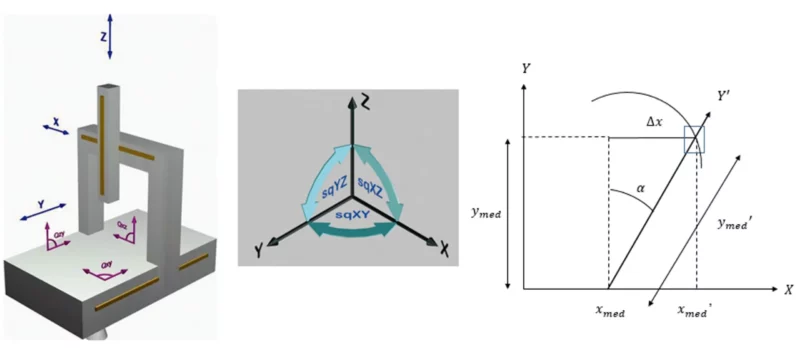
Abstract The lack of geometric and dimensional accuracy of parts produced by additive manufacturing (AM) is directly related to the machine, material and process used. This paper aims to propose a method for the analysis and compensation of machine-related geometric errors applicable to any AM machine, regardless of the manufacturing [...]

Virtual-point based geometric error compensation model for additive manufacturing machines2026-11-10T09:59:04+00:00
14 06, 2017

Optical characterisation of materials for precision reference spheres for use with structured light sensors

2026-11-10T10:03:00+00:00

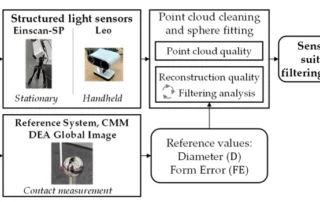
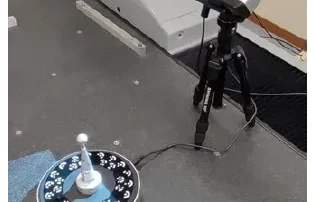
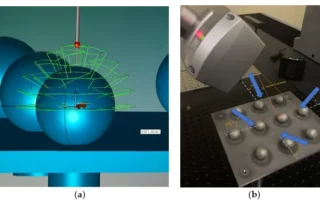
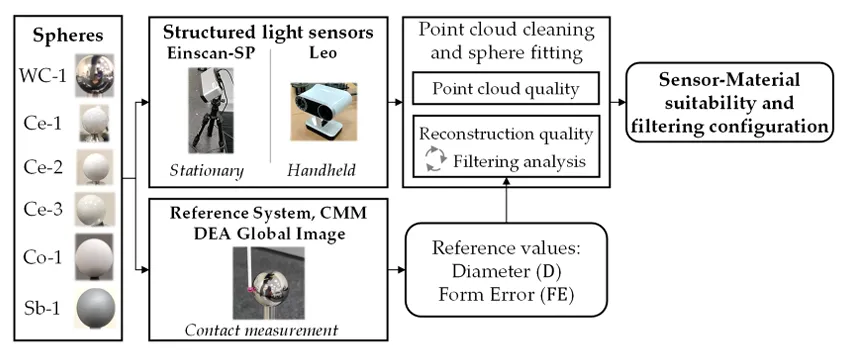
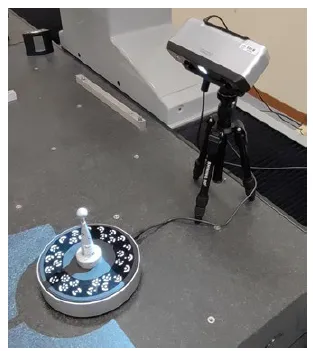
Abstract Traditionally, 3D digitizing sensors have been based on contact measurement. Given the disadvantages of this type of measurement, non-contact sensors such as structured light sensors have gained the attention of many sectors in recent years. The fact that their metrological performance is affected by the optical properties of the [...]

Optical characterisation of materials for precision reference spheres for use with structured light sensors2026-11-10T10:03:00+00:00
14 06, 2017

Characterisation of the performance of a structural light digitizing sensor by using different materials and surface finishes

2026-09-22T10:28:59+00:00

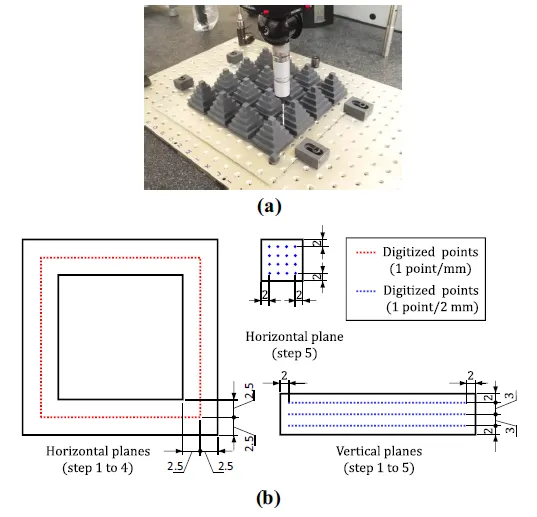
Abstract The advantages of non-contact digitising systems over contact systems are undeniable. They allow capturing more information per unit of time with less accessibility problems and without alter the digitised surface. Although many of these systems have been developed with the aim of replacing contact systems in metrological verification tasks, [...]

Characterisation of the performance of a structural light digitizing sensor by using different materials and surface finishes2026-09-22T10:28:59+00:00
13 06, 2017

Conoscopic Holography feasibility for form error in-situ monitoring in Additive Manufacturing

2026-11-10T10:09:07+00:00

Abstract The lack of standardization and the low quality of parts produced by Additive Manufacturing requires in certain cases the use of in-situ monitoring techniques based on the use of different types of sensors, each of which has advantages and disadvantages depending on the type and nature of the signatures [...]

Conoscopic Holography feasibility for form error in-situ monitoring in Additive Manufacturing2026-11-10T10:09:07+00:00
13 06, 2017

On-machine non-contact roughness verification system based on Conoscopic holography

2026-11-10T10:11:18+00:00

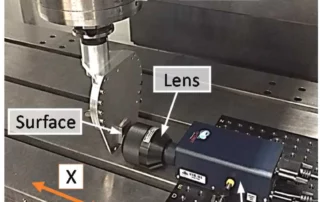
Abstract The surface quality verification of mechanical components is an essential activity in many applications where surface performance plays an important role in the functional behaviour of the part. Although many of the verification techniques commonly employed are based on the use of contact roughness profilometers, there are some limitations [...]

On-machine non-contact roughness verification system based on Conoscopic holography2026-11-10T10:11:18+00:00
12 06, 2017

Comparison of Chemical and Mechanical Surface Treatments on Metallic Precision Spheres for Using as Optical Reference Artifacts

2026-11-10T10:13:20+00:00

Abstract The improvement of industrial manufacturing processes requires measurement procedures and part inspection tasks to be faster and faster while remaining effective. In this sense, the capabilities of noncontact measuring systems are of great help, not only because of the great amount of data they provide but also for the [...]

Comparison of Chemical and Mechanical Surface Treatments on Metallic Precision Spheres for Using as Optical Reference Artifacts2026-11-10T10:13:20+00:00
11 06, 2017

A procedure to integrate a CIS sensor in an additive manufacturing machine for In-situ digitizing of deposited material layers

2026-11-10T10:17:00+00:00

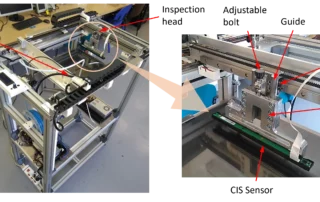
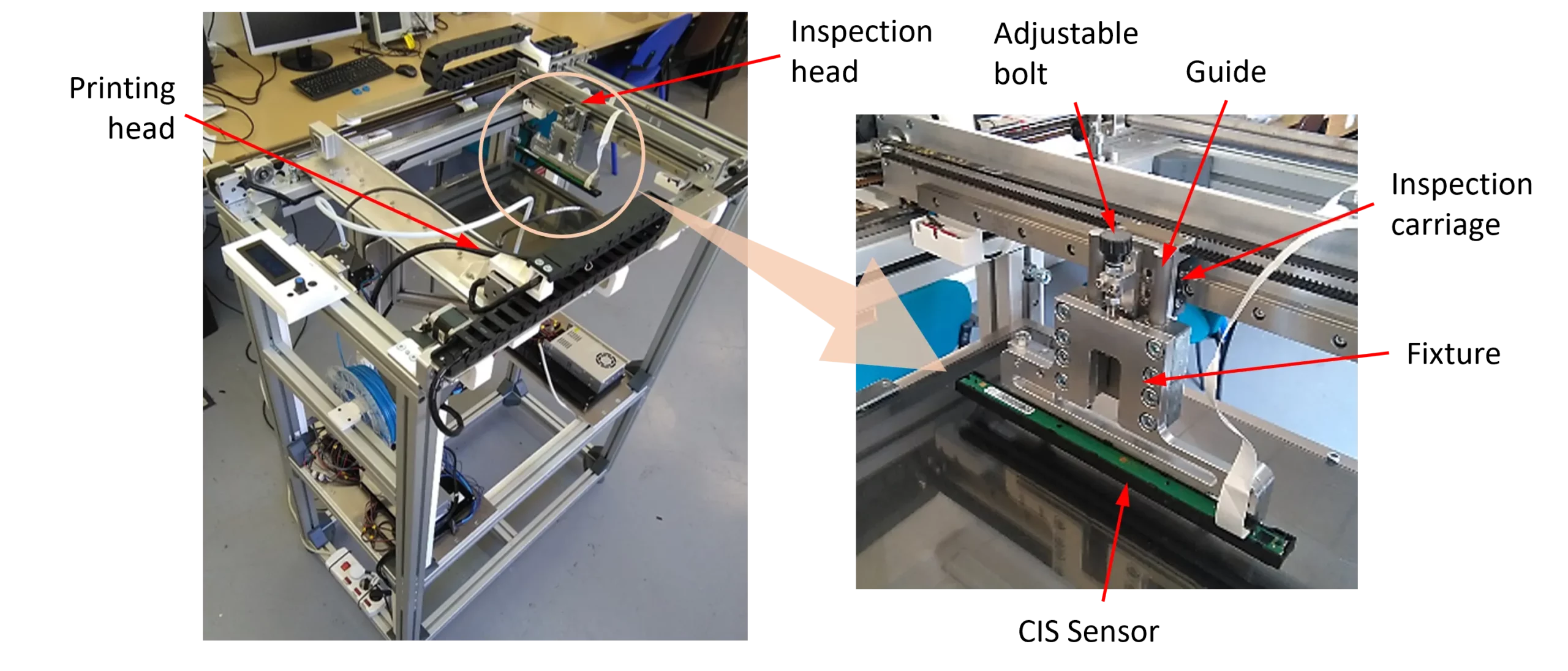
Abstract A notable constraint to the industrial application of additive manufacturing processes is the lack of geometric accuracy of the parts produced. In-situ inspection systems, therefore, need to be developed to detect and compensate for any geometric deviations that appear during the process. This article proposes a noncontact system for [...]

A procedure to integrate a CIS sensor in an additive manufacturing machine for In-situ digitizing of deposited material layers2026-11-10T10:17:00+00:00
10 06, 2017

Novel post-processing procedure to enhance casting molds manufactured by binder jetting AM

2026-10-06T09:46:09+00:00

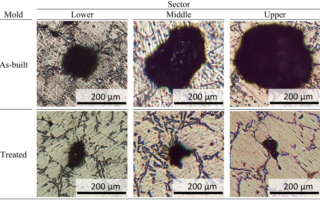
Abstract The significant improvements made in additive manufacturing (AM) techniques since their beginnings, coupled with its intrinsic advantages, have resulted in a technology that stands out as most suitable for applications in leading sectors today. In addition to some of the properties of the parts, there are also some inherent [...]

Novel post-processing procedure to enhance casting molds manufactured by binder jetting AM2026-10-06T09:46:09+00:00
Go to Top